

If you own a rental home in Houston, the answer to “what can I deduct?” is most of what it costs to earn the rent: mortgage interest, property taxes, insurance, repairs, management fees, utilities you pay, advertising, and depreciation on the building. The catch is timing. For most owners the tax year ends December 31, and what you pay, document and decide in the next nine weeks shapes your 2026 return.
This checklist walks through the rental property tax deductions Houston landlords use most, the year-end moves worth making now, and the mistakes that cost owners money. It is current as of October 28, 2026, and it applies to the 2026 tax year. The latest IRS Publication 527 on the IRS site is the 2025 edition, so we also checked the 2026 changes noted below against IRS announcements.
This article is general information for Houston rental owners, not tax, legal or financial advice. Tax rules change and every owner’s situation is different. Confirm anything you plan to rely on with a licensed CPA or enrolled agent. Information current as of October 28, 2026.
First, what counts as rental income
Rent is taxable, and Texas does not add a state income tax on top of it. That makes your federal return the one that matters. Most owners report rentals on Schedule E (Form 1040). According to IRS Publication 527, you include:
- Rent you receive, including advance rent, in the year you receive it, no matter which period it covers.
- A payment a tenant makes to cancel a lease.
- A security deposit only if you keep it, for example because the tenant broke the lease.
A security deposit you intend to return is not income. If you are not sure how to handle deposits at move-out, our guide to Texas deposit rules covers the 30-day refund window.
The rental property tax deductions Houston landlords use most
Publication 527 lists the standard rental expenses. Here is that list translated into what it looks like on a Houston rental.
| Deduction | What it looks like in Houston | Notes |
|---|---|---|
| Mortgage interest | Interest on the loan used to buy or improve the rental | Principal is not deductible. Lenders send Form 1098 in January. |
| Property taxes | Harris County and other taxing unit bills | Deducted on Schedule E, not Schedule A. |
| Insurance | Landlord policy, flood, windstorm where carried | Premiums for the rental only, not your own home. |
| Repairs and maintenance | HVAC service, plumbing fixes, painting, lawn care | Must be a repair, not an improvement. |
| Management fees | Monthly fee, leasing fee, renewal fee | Listed in Publication 527. |
| Advertising and commissions | Listing photos, syndication, leasing commissions | Tenant placement costs count. |
| Utilities | Water, trash, electricity you pay while vacant or as owner | Not what the tenant pays. |
| Legal and professional | CPA, attorney, eviction filing costs | Keep the invoice. |
| Travel and mileage | Trips to inspect or repair the property | Log date, miles and purpose. |
| Depreciation | The building, over 27.5 years | Explained below. |
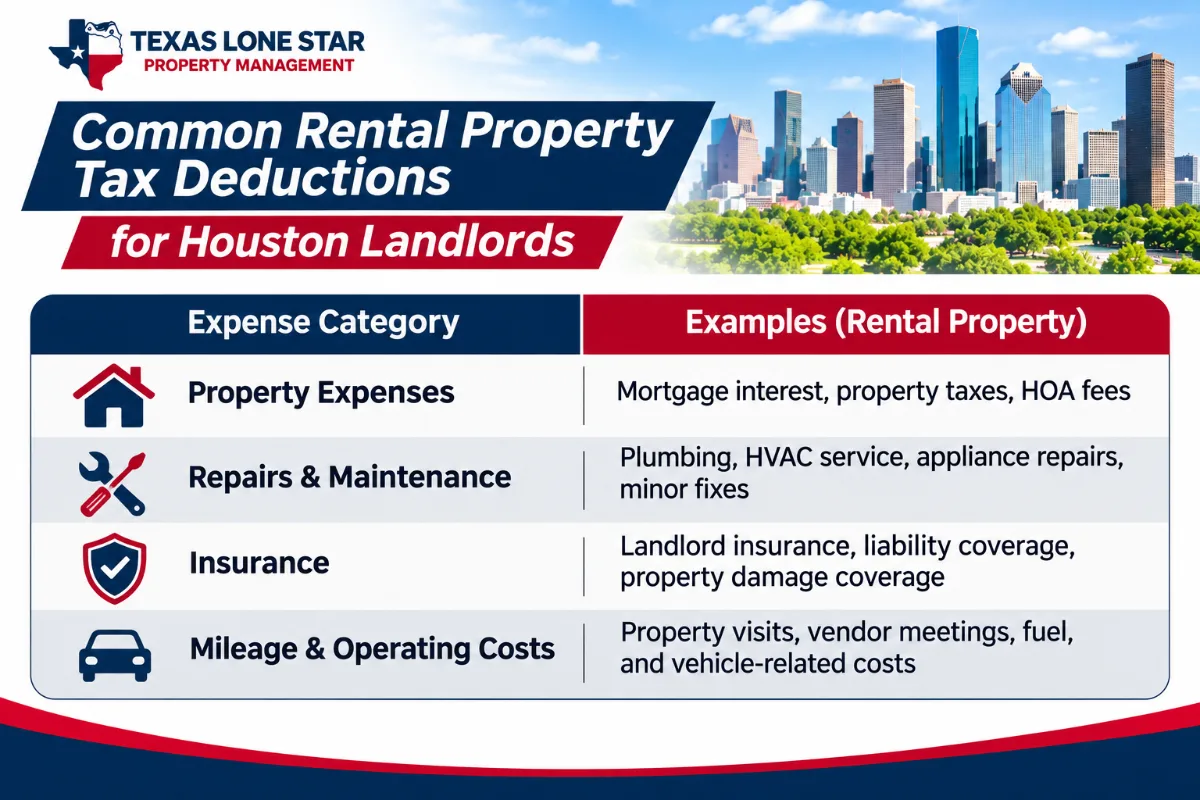
Two notes on the table. First, the IRS sets a business standard mileage rate of 72.5 cents per mile for 2026 (up from 70 cents in 2025), as shown in the IRS standard mileage rate announcement. Only trips for the rental count, and you need a log. Second, if you hire a manager, property management fees are fully part of your operating costs, which is worth remembering when you compare the price of managing it yourself against hiring help.
Repairs vs. improvements: the line that trips up owners
This is the most common place owners get it wrong. An ordinary repair keeps the property in working condition and is generally deducted in the year you pay. An improvement is a betterment, a restoration or an adaptation to a new use, and it has to be capitalized and depreciated. Publication 527 puts it simply: an expense is for an improvement if it results in a betterment to your property.
| Usually a repair (deduct now) | Usually an improvement (depreciate) |
|---|---|
| Fixing a leaking faucet | Replacing all plumbing |
| Patching a roof leak | Replacing the whole roof |
| Repainting a room between tenants | Adding a room or garage |
| Replacing a broken window pane | Upgrading every window to a better type |
| Servicing the AC unit | Installing a new HVAC system |
Houston owners run into this after storms and flooding, when a repair job can turn into a restoration. If a contractor’s invoice mixes both, ask for it to be itemized.
The IRS offers three safe harbors that can simplify this. See the IRS tangible property regulations page for the details:
- De minimis safe harbor: items up to $2,500 per invoice or item can be expensed if you do not have audited financial statements.
- Safe harbor for small taxpayers: for buildings with an unadjusted basis under $1 million, total repairs and maintenance for the year can be expensed if they stay under the lesser of 2% of that basis or $10,000.
- Routine maintenance safe harbor: recurring work you expect to do more than once in 10 years to keep a building in efficient operating condition.
These are annual elections made by attaching a statement to a timely filed return, so tell your preparer early, not in April.
Depreciation: the deduction that does not cost you cash
Depreciation lets you deduct a slice of the building’s cost every year even though you did not spend anything that year. For a residential rental, the recovery period is 27.5 years, and it starts when the property is ready and available for rent, even if a tenant has not moved in yet.
A simple example: you bought a Houston rental for $280,000 and your county appraisal puts $60,000 on the land. Your building basis is $220,000. Divided by 27.5 years, that is $8,000 of depreciation in a full year. Land is never depreciated.
Newer rules may speed some of this up. The 100% special depreciation allowance applies to qualified property acquired and placed in service after January 19, 2025. The building itself does not qualify, but shorter-lived items such as appliances and carpet can, so ask your CPA whether it fits your rental.
Depreciation reduces your basis, and the IRS generally taxes it when you sell. The deduction is real and worth taking, but plan for it before you list a property. Do not skip depreciation to avoid this, because the IRS treats it as allowed whether or not you claimed it.
Other deductions and limits worth knowing
Qualified business income (QBI) deduction. Many owners can deduct up to 20% of qualified business income from a rental that rises to the level of a trade or business. The deduction was made permanent in 2025. A safe harbor in Revenue Procedure 2019-38 includes a 250-hour services test and separate books, so keeping a time log can matter. Ask your CPA whether your rental qualifies.
Passive loss rules. If your deductions exceed your rent, the loss is usually passive. Owners who actively participate can deduct up to $25,000 against other income, phased out as modified adjusted gross income goes from $100,000 to $150,000. Anything disallowed carries forward. IRS Topic 425 and Publication 925 cover it.
Property taxes and the SALT cap. Because your rental taxes are deducted on Schedule E, they are not squeezed by the cap that limits the state and local tax deduction on Schedule A. If you think your appraisal is too high, learn how to protest your Harris County property tax appraisal before next spring.
1099s for contractors. If you pay an unincorporated vendor, the Form 1099-NEC and 1099-MISC threshold is $2,000 for payments made after December 31, 2025. Get a W-9 before the first payment.
Your year-end checklist (before December 31)

- Pay what is due. Most owners use the cash method, so a bill paid by December 31 lands in 2026. Property tax bills usually arrive in the fall and are due by January 31.
- Finish planned repairs. If a repair is already needed, doing it before year end moves the deduction into 2026. Do not spend money you do not need to spend just for a deduction.
- Itemize every contractor invoice so repairs and improvements are separated.
- Total your mileage and confirm the log shows date, miles and purpose.
- Collect W-9s for every vendor you paid in 2026.
- Reconcile income against your bank statements, including late fees, pet charges and kept deposits.
- Note the date a property was placed in service if you bought or finished a rental this year.
- Gather statements: Form 1098, insurance invoices, tax bills, management statements.
- Book your CPA for January, not April.
Owners who use a property manager receive a monthly statement and an annual owner summary, which makes this checklist much shorter. If you are weighing options, read how to self-manage or hire a Houston property manager.
Common mistakes to avoid
- Deducting principal. Only the interest portion of a mortgage payment is deductible.
- Mixing personal and rental spending. Use a separate bank account for the rental.
- Deducting improvements as repairs. It is the issue auditors look for most.
- Forgetting depreciation. Missing it does not protect you. The IRS treats it as allowed anyway.
- Poor records. No receipt, no deduction, in practice.
Planning ahead for next year also helps. Setting lease end dates for the spring and summer leasing season can cut vacancy, and the Houston rental market trends page shows where rents are heading. More owner guides are on our Houston landlord resources page.
Let us handle the paperwork side of owning a rental
Good records are easier when someone else collects rent, pays vendors and sends clean monthly statements. Texas Lone Star Property Management handles leasing, maintenance coordination and owner reporting for Houston-area homes, so year end is a short conversation with your CPA instead of a shoebox of receipts. If you would like a free look at what that would cost for your property, reach out and we will walk through it with you.
Texas Lone Star Property Management can take rent collection, maintenance and owner statements off your plate. Contact us for a no-pressure review of your rental and a clear picture of your costs.
Frequently Asked Questions
Is rental income taxable in Texas?
Yes at the federal level. Texas has no state personal income tax, but rent you collect is income on your federal return, usually reported on Schedule E. Advance rent counts as income in the year you receive it, and so does a payment a tenant makes to cancel a lease. A security deposit you plan to return is not income until you keep it.
Are property management fees tax deductible?
Yes. IRS Publication 527 lists management fees as a deductible rental expense, along with commissions, advertising, insurance, repairs, utilities and professional fees. Keep the monthly statements and the management agreement with your records.
How does rental property depreciation work?
Residential rental buildings are depreciated over 27.5 years, starting when the property is ready and available for rent. Land is not depreciable, so you divide your cost between land and building. A building basis of $220,000 works out to $8,000 a year in a full year of depreciation. Depreciation lowers your basis and is generally taxed when you sell, so talk to a CPA before you do.
What is the difference between a repair and an improvement?
A repair keeps the property in ordinary working condition, such as fixing a leak or patching a section of drywall, and is usually deducted in the year you pay for it. An improvement adds value, restores the property or adapts it to a new use, such as a full roof replacement, and must be capitalized and depreciated. IRS safe harbors can let you deduct some borderline costs.
Do I have to send a 1099 to my contractors?
If you operate your rental as a business and pay an unincorporated contractor, the reporting threshold for Forms 1099-NEC and 1099-MISC rises from $600 to $2,000 for payments made after December 31, 2025. That means 2026 payments use the new threshold, with forms due in early 2027. Collect a W-9 before you pay anyone, and ask your CPA how it applies to you.
Can I take a loss on my rental to reduce my other income?
Only within limits. Rental losses are generally passive. If you actively participate in the rental, the IRS allows up to $25,000 of loss against other income, and that allowance phases out as your modified adjusted gross income rises from $100,000 to $150,000. Disallowed losses carry forward. Publication 925 has the rules.


