

Protest — and if you are reading this in the fall, your next window opens in the spring. For almost every non-owner-occupied Houston rental, in almost every year, filing is the right call: it is free, it costs nothing if you lose, and the value the appraisal review board certifies becomes the base your tax bill is built on. The deadline is May 15 or the 30th day after Harris Central Appraisal District delivered your notice of appraised value, whichever is later. The 2026 cycle has closed. Everything below is what to have ready before the next notice lands.
This is general information, not tax or legal advice, and is current as of September 2026. Confirm current-year figures and deadlines with HCAD or the Texas Comptroller, and talk to a Texas attorney or a registered property tax consultant about your specific property.
The squeeze is on the carrying-cost side of your P&L
Rent growth across Harris County has flattened while the two largest fixed costs of owning a Houston rental have not. Appraised values have climbed through repeated reappraisals, and Gulf Coast insurance has been the sharper shock: Houston is the most expensive major metro in Texas for property insurance, with average annual premiums reported around $5,653, and carriers kept filing single-digit increases into 2026 on reinsurance costs, windstorm and hail losses, and higher rebuild costs.
If gross rent is flat and both of those rise several percent, net operating income falls even though nothing about the property changed. Insurance you fight by shopping the policy and hardening the roof. Taxes you fight once a year, inside the narrow window set by Section 41.44 of the Texas Tax Code.
Miss it and you generally lose the year. The appraisal review board can hear a late protest only if you show good cause before it approves the appraisal records, or if you fall into a narrow statutory exception. Calendar the date the day your notice arrives, and file even if your evidence is not ready — you can add evidence later, but you cannot add a filing.
Why your rental gets no 10% cap
This is the single most misunderstood point among small Houston landlords, and it costs people real money.
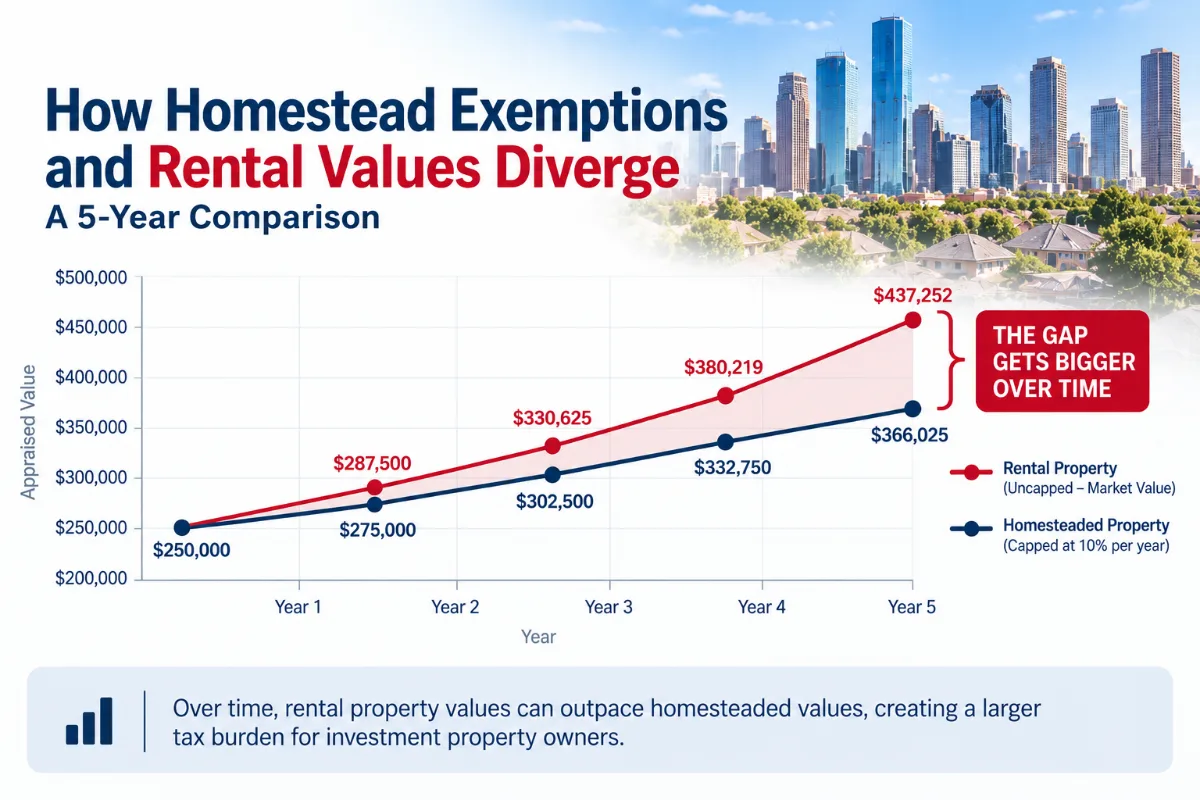
The 10 percent appraisal cap everyone talks about lives in Section 23.23 of the Tax Code, and it applies only to a residence homestead — a property the owner occupies and has qualified for the homestead exemption. It takes effect January 1 of the tax year after the owner qualifies and ends January 1 of the tax year after they stop qualifying. The moment you move out and rent the house, the cap comes off.
That compounds in a way owners underestimate. A homesteaded house whose market value runs up 15 percent a year has its taxable base held to 10, and the gap grows into a cushion worth thousands. Convert that house to a rental and the cushion vanishes: the base resets toward full market value with no percentage limit on the jump, so three years of strong appraisal growth lands straight in your tax bill while the identical house next door, still owner-occupied, absorbs a fraction of it. The larger homestead exemption Texas voters approved in November 2025 works the same way — homestead-only, and a rental sees none of it.
There is one temporary exception, and it is on a clock: the circuit breaker limitation in Section 23.231 holds qualifying non-homestead appraisal increases to 20 percent a year, but only for a fixed set of tax years. HCAD’s circuit breaker cap page is the plainest summary of how it is calculated and who is excluded.
For tax years 2024, 2025 and 2026 only, Texas applies a 20 percent limitation to qualifying non-homestead real property under a value ceiling — $5,000,000 for 2024, indexed for inflation since. It applies automatically; there is no application to file. HCAD states the Legislature authorized it only for those three tax years and that it expires December 31, 2026. Bills to extend it did not pass in 2025. Plan on 2027 rental appraisals having no cap at all, and confirm the current-year ceiling with HCAD or the Comptroller before relying on it.
How to read your notice of appraised value
The notice HCAD sends is required by Section 25.19, which sets an April 1 target for single-family homes with a homestead exemption and May 1 for everything else, “or as soon thereafter as practicable.” Rentals sit in the second bucket, so expect yours later than your neighbor’s. Read these lines, in this order:
- Market value. What the district believes the property would sell for. This is the number a market-value protest attacks.
- Appraised value (net appraised or capped value). The number taxes are actually calculated on. If a circuit breaker applies, the notice shows both this and the higher market value.
- Last year’s appraised value and taxable value for each taxing unit. Your year-over-year comparison, and the fastest way to spot a jump that needs explaining.
- Exemptions listed. A homestead exemption still showing on a converted rental is a correction, not a protest — and leaving it can trigger back taxes and penalties.
- The taxing units. County, city, school district, community college, and any MUD or emergency services district. A wrong unit is its own protest ground.
- The deadline printed on the notice. That date governs your 30-day calculation.
The grounds: market value versus unequal appraisal
The full menu of protest grounds sits in Section 41.41. Two of them carry almost every residential rental case, and they take different evidence.
Market value says the number is simply too high — the property would not sell for that. Make this argument when the house has real problems: deferred maintenance, foundation movement, an aging roof, a location the district’s model did not weight properly. Evidence is closed sales of genuinely similar properties near the January 1 valuation date, repair estimates and invoices, and photographs of condition.
Unequal appraisal says the number may be arguable in isolation but is out of line with comparable properties. The equity standard courts apply lives in Section 42.26, and the prong that fits most owners asks whether the appraised value exceeds the median appraised value of a reasonable number of comparable properties, appropriately adjusted. Evidence here is not sales — it is the district’s own values on similar properties, pulled from HCAD’s public records, adjusted for size, age, condition and location, and reduced to a median.
Unequal appraisal is often the stronger play in a rising market, because you do not have to prove the market is soft — only that the district treated you differently from properties like yours. You may argue both grounds in the same protest, and you should. You are also entitled under Section 41.461 to request, free of charge, the data, schedules, formulas and other information the chief appraiser will introduce at your hearing, and the district must tell you so at least 14 days out.
Request the appraisal district’s hearing evidence in writing the same day you file, then read it before building your own packet. Their comparables tell you which argument to lead with, and correcting a wrong square footage or condition code in their file is often the whole case.
The protest timeline, step by step
The sequence below follows the Texas Comptroller’s appraisal protests and appeals guidance, with the Harris County specifics filled in.
- Spring — the notice arrives. Read it, calendar the deadline, and note whether the printed deadline is later than May 15.
- File the notice of protest. In Harris County, most owners use HCAD’s online protest filing system through the owner portal. A written notice is sufficient if it identifies you, identifies the property, and shows dissatisfaction with a district determination; you are not required to use the official form, and the district may not charge a fee to file.
- Give an opinion of value and upload evidence. HCAD’s iSettle path can produce a settlement offer you accept or decline without a hearing, but it requires you to state what the property is worth and upload support inside the district’s own short window. Check that window in the portal.
- Informal conference. Meet with an appraiser to try to settle before the formal hearing. Most protests end here. Bring the packet you would bring to the board.
- Formal ARB hearing. You get notice of date, time, place and subject at least 15 days out, plus the Comptroller’s taxpayer pamphlet and the board’s hearing procedures at least 14 days out. You may appear in person, by phone or videoconference, or by sworn affidavit — useful for out-of-town owners.
- The order and any appeal. The board’s written determination binds for that tax year only. You generally have 60 days from receiving it to petition district court, and depending on value and property type you may instead use regular binding arbitration or, above $1 million, the State Office of Administrative Hearings.

Your evidence checklist for a rental
A rental gives you evidence a homeowner does not have. Use it.
- Rent roll and lease history. Actual rents, vacancy and concessions. If the property will not command the rent the district’s value implies, that is an income argument.
- Condition photographs, dated. Roof, foundation, HVAC age, flooring, cabinets, siding, drainage. Shoot the problems, not the staging.
- Repair invoices and contractor estimates. Paid invoices for work already done and written bids for work still needed as of January 1. An unrepaired $14,000 foundation bid comes straight off market value.
- Turnover and make-ready costs for the last two years, which show real condition better than any adjective.
- Comparable sales near the January 1 valuation date — same submarket, similar size, age and condition, with adjustments shown.
- Equity comps pulled from HCAD’s own appraised values on similar properties, adjusted, with your median calculation written out.
- Insurance declarations and premium history, useful context for a property with elevated windstorm or flood exposure.
- Anything a tenant made worse and you have not yet fixed. Your obligations under Texas landlord-tenant law still apply, but if the damage was real on January 1, it belongs in the file.
Bring copies. Boards work from paper as often as screens.
DIY or hire a firm? The honest economics
Run the number first. A reduction is worth roughly the value knocked off times your combined tax rate — in much of Harris County that lands near 2 to 2.5 percent once county, city, school and special districts stack up. Drop a $340,000 appraisal to $305,000 and you have saved on the order of $700 to $875 for the year.
Now price the two paths. Doing it yourself costs a free filing and perhaps four to eight hours of gathering comps, photographing the property and sitting through an informal meeting. You keep every dollar. Most Texas protest firms work on contingency — commonly between a quarter and half of the first year’s tax savings, with nothing owed if they win nothing. On the example above, a 40 percent fee leaves you roughly $420 to $525; a 25 percent fee leaves about $525 to $655.
Paid consultants must be registered under Texas Occupations Code Chapter 1152, are regulated by the Texas Department of Licensing and Regulation, and may not solicit an assignment by promising a specific outcome. We found no statutory cap on the contingency percentage, so read the contract: the percentage, whether it applies to first-year savings only, whether a flat minimum kicks in on a small reduction, and how the agent appointment ends.
The rule of thumb: hire a firm if you own several doors, if the account is complex, or if you know you will not show up — an unrepresented owner who no-shows gets nothing. Do it yourself if you own one or two houses and your comps are clean. If a manager already handles your Houston property management, ask whether protest coordination is included before signing a separate contingency agreement; you may be paying twice.
Your bill is appraised value, minus exemptions, times the combined rate adopted by every taxing unit that touches the parcel. The appraisal district sets value. The county, city, school district and special districts set rates months later. A successful protest is real money, but it does not touch the rate — and it binds only for that tax year, so you file again next spring.
What to do between now and spring
Pull your last notice and chart the value trend over three years. Confirm no stale homestead exemption is sitting on a converted rental. Start a folder now for condition photos, invoices and bids, because January 1 is the valuation date and evidence created after the fact is weaker. Sign up for electronic notices with HCAD so nothing sits in a mailbox while your 30 days run. Then, when it lands, file. If you would rather not run that calendar yourself, our pricing shows what full-service management covers.
Texas Lone Star Property Management tracks appraisal notices, deadlines and hearing dates for the Houston and Harris County rentals we manage, and we keep the rent rolls, invoices and condition records that make a protest winnable. Reach out and we will look at your next notice of appraised value with you.
Frequently Asked Questions
What is the deadline to file a Texas property tax protest?
Under Tex. Tax Code § 41.44(a)(1), your written notice of protest is due not later than May 15 or the 30th day after the date the appraisal district delivered your notice of appraised value, whichever is later. The 30 days run from the district’s delivery date, not the day the envelope reached your mailbox. May 15 is a floor, not a ceiling — if your notice went out in late April, your real deadline is later than May 15.
Are there any exceptions to the protest deadline?
A few, and they are narrow. Under § 41.44(b) the appraisal review board may hear a late protest filed before it approves the appraisal records if you show good cause. Subsection (c-1) covers owners who were working in the Gulf of Mexico for at least 20 days spanning the deadline, and (c-2) covers owners on full-time active duty outside the United States, both with documentation. Section 41.411 lets you protest a notice the district was required to send but never did, so long as you file before the taxes go delinquent.
Does the 10% homestead cap protect my Houston rental?
No. The appraisal limitation in § 23.23 applies only to a residence homestead — a property the owner occupies and has qualified for the homestead exemption. A non-owner-occupied rental never qualifies, so its appraised value can move to full market value in a single year with no percentage limit. The $140,000 school-district homestead exemption Texas voters approved in November 2025 is likewise homestead-only and does nothing for a rental.
Is there any cap at all on a non-homestead rental in 2026?
For the 2026 tax year, yes — temporarily. Tex. Tax Code § 23.231 created a 20 percent circuit breaker limitation on qualifying non-homestead real property under a value ceiling ($5,000,000 for 2024, indexed since). HCAD states the Legislature authorized it only for the 2024, 2025 and 2026 tax years, and it expires December 31, 2026. Unless a future Legislature extends it, 2027 appraisals for rentals will have no cap at all. Confirm the current year’s value ceiling with HCAD or the Comptroller.
What are the grounds for a protest?
Section 41.41(a) lists them. The two that matter for most rental owners are (1) the determination of appraised value — your property is appraised above market value — and (2) unequal appraisal, meaning it is appraised higher than comparable properties even if the number is arguably defensible on its own. You can also protest exemption denials, ownership errors, wrong taxing units, and a determination that your property does not qualify for the circuit breaker limitation.
What is unequal appraisal and why does it matter more than market value?
Unequal appraisal is the equity argument: your assessment is out of line with your neighbors regardless of what the property would sell for. The standard in § 42.26(a)(3) asks whether the appraised value exceeds the median appraised value of a reasonable number of comparable properties, appropriately adjusted. It matters because it does not require you to prove the market is soft — only that the district treated you differently from similar properties, which is often easier to document from the district’s own records.
Does winning a protest lower my tax rate?
No. A protest changes the value the tax is calculated on, not the rate. Your bill is roughly appraised value, minus exemptions, times the combined rate set by the county, city, school district, and any MUD or other special districts. Those taxing units adopt their rates in the late summer and fall, entirely separately from the appraisal district. Lowering the base is the only lever a protest gives you.
Are property tax protest companies worth it?
It depends on your time and your evidence. Most Texas firms work on contingency, commonly a quarter to half of the first year’s tax savings, with nothing owed if they get no reduction. Paid property tax consultants must be registered under Texas Occupations Code Chapter 1152 and are regulated by TDLR; we found no statutory cap on the contingency percentage, so the number in your contract is the number. A firm earns its fee when you own several properties, when the account is complex, or when you will not realistically show up to a hearing. If you own one house, have clean comps, and will do the work, filing yourself keeps 100 percent of the savings.


