
If you own rental property in Houston, hurricane preparedness isn’t optional — it’s part of the job. Houston sits in one of the most
Hurricane-prone corridors in the country. Harvey dumped 60+ inches of rain in 2017. Beryl knocked out power for over a million residents in 2024. And every year between June and November, landlords face the same question: are your properties — and your legal obligations — ready?
This guide covers what Houston landlords are legally required to do, what you should do even if the law doesn’t require it, and exactly how to prepare your rental properties before the first named storm of the season rolls in.
Table of Contents
- Your Legal Duties as a Houston Landlord Before a Storm
- Pre-Season Property Inspection Checklist
- When a Storm Is Approaching: What to Do
- After the Hurricane: Landlord Responsibilities
- Insurance: What You Need and What You’re Probably Missing
- Communicating With Tenants Before and After a Storm
- Frequently Asked Questions
Your Legal Duties as a Houston Landlord Before a Storm
Texas law doesn’t have a specific “hurricane preparedness” statute, but existing landlord-tenant law creates real obligations that come into sharp focus when a storm hits.
Habitability Requirements
Under Texas Property Code §92.056, landlords must repair conditions that materially affect the health or safety of an ordinary tenant. A leaking roof, structural damage, broken windows, or flooded living areas all meet this standard. If hurricane damage creates uninhabitable conditions and you fail to make timely repairs after a written tenant notice, your tenant may have the right to:
- Terminate the lease without penalty
- Repair the issue themselves and deduct the cost from the rent
- Withhold rent until repairs are made
- Sue for damages, court costs, and attorney fees
The best protection is being proactive before storm season — not scrambling to respond after the fact.
Flood Zone Disclosure
⚠️ Required by Texas Law
Texas Property Code §92.0135 requires landlords to disclose in writing if a rental property is located in a FEMA 100-year floodplain (Special Flood Hazard Area). This disclosure must be included in or attached to the lease before move-in. Skipping this step exposes you to legal liability — especially after a flood event. Check your property’s flood zone status at msc.fema.gov.
Security Devices Must Be Functional
Under Texas Property Code §92.153–92.156, landlords must provide and maintain functional door locks, window latches, and security devices. In a hurricane context, window integrity matters — both for habitability and for preventing storm damage. Make sure all window locks and frames are in good repair before storm season.
Recommend (or Require) Renters Insurance
Landlord insurance covers the structure. It does not cover your tenant’s personal belongings. A well-dr
afted lease should strongly recommend renters’ insurance, and many landlords now require it as a lease condition. Make sure tenan
ts understand that their furniture, electronics, and clothing are their responsibility — not yours — in a flood or wind event.
Pre-Season Property Inspection Checklist
The best time to address vulnerabilities in your rental is before hurricane season, not during a watch or warning. Run through this checklist every April–May for each property you own.
Roof & Exterior
Have a licensed roofer inspect annually. Small issues can become major damage under 100+ mph winds.
Drainage & Flood Prevention
Houston’s flat topography and clay soil make flooding a serious concern during major storms.
Electrical & Mechanical
Power outages are common during major storms. These checks can help reduce post-storm damage and emergency maintenance calls.
When a Storm Is Approaching: What to Do
When the National Hurricane Center puts Houston in the cone, the window to act is 48–72 hours. Here’s what to do — and what to communicate to your tenants.
Your Immediate Property Actions
💡 48–72 Hours Before Landfall: Landlord Action List
- Walk or drive by each property if possible to document current condition (photos + video)
- Contact your property insurance carrier to confirm your policy is active and review coverage limits
- Secure any loose outdoor items at vacant or common-area spaces (pool furniture, signage, etc.)
- Notify tenants in writing of storm prep steps they should take inside the unit
- Confirm your contractors and maintenance vendors have your contact info and are aware of storm season protocols
- Review your emergency contact list — who handles post-storm damage assessment and water remediation?
What You’re Responsible For vs. What Tenants Handle
| Task | Landlord | Tenant |
|---|---|---|
| Secure loose outdoor furniture/items | Common areas only | Their personal items |
| Board up or shutter windows | ✓ Landlord | — |
| Move personal belongings to higher ground | — | ✓ Tenant |
| Evacuate if under mandatory order | Notify tenant | ✓ Tenant’s decision |
| Roof and structural repairs after storm | ✓ Landlord | — |
| Damage to tenant’s furniture/electronics | Not liable* | ✓ Tenant’s renters insurance |
| Emergency mold remediation | ✓ Landlord | — |
| Temporary housing if unit is uninhabitable | Generally not required** | Tenant arranges |
*Unless landlord negligence contributed to the damage. **Review your lease — some management agreements differ.
After the Hurricane: Landlord Responsibilities
The
storm passed. Now the clock starts. How quickly and professionally you respond to post-storm damage will determine both your legal exposure and your tenant relationships.
Step 1: Document Before You Touch Anything
Before any cleanup begins, photograph and video every area of damage. This documentation is essential for your insurance claim, and it protects you from tenant claims that damage existed before the storm. Use a date-stamped camera app or walk through with a contractor who can provide a written damage assessment.
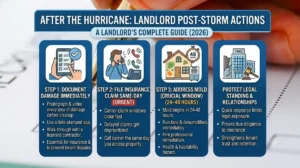
Step 2: File Your Insurance Claim Immediately
Don’t wait. Most insurance carriers have claim response windows and may deprioritize delayed claims during a major storm event when thousands of claims are filed simultaneously. Call your carrier the same day you can safely access the property.
Step 3: Address Mold Within 24–48 Hours
⚠️ Mold Is a Houston-Specific Emergency
Houston’s heat and humidity create ideal mold conditions. After any flooding or roof intrusion, mold can begin growing within 24–48 hours. Under Texas Property Code §92.056, mold that affects habitability is a required repair — and tenants who get sick due to a known, unaddressed mold problem can sue. Engage a licensed water mitigation and mold remediation company immediately after any flood event.
Step 4: Communicate Your Timeline to Tenants in Writing
Tenants are stressed after a storm. A clear, written communication from you — even if you don’t have all the answers yet — goes a long way toward preserving the relationship and limiting legal risk. Something as simple as: “I’m aware of the damage and have contacted my insurance carrier and a contractor. I’ll have a repair timeline for you within 48 hours” is far better than silence.
For more on how Texas landlord-tenant law handles habitability and repair timelines, see our complete Texas landlord-tenant law guide.
Step 5: Know When to Allow Lease Termination
If the property is genuinely uninhabitable for an extended period, fighting a tenant who wants to leave can cost you more in legal fees and lost goodwill than simply letting them go. Document the damage, work out a mutual lease termination if appropriate, return any unused prepaid rent, and move forward with repairs.
Insurance: What You Need and What You’re Probably Missing
This is the area where Houston landlords are most commonly underinsured — sometimes catastrophically so.
| Policy Type | What It Covers | Required in Houston? |
|---|---|---|
| Landlord/Dwelling Policy (DP-3) | Structure, wind damage, fire, vandalism, liability | Required if mortgaged |
| Flood Insurance (NFIP or Private) | Flood and storm surge damage — NOT covered by DP-3 | Required in flood zones; recommended everywhere in Houston |
| Loss of Rents Coverage | Lost rental income while property is uninhabitable for repairs | Not required; strongly recommended |
| Umbrella Liability Policy | Excess liability above standard policy limits | Not required; recommended for 3+ units |
| Tenant Renters Insurance | Tenant’s personal property and liability | Require in lease — protects everyone |
💡 Critical: Standard Landlord Insurance Does NOT Cover Flooding
This surprises many Houston landlords. Your standard DP-3 policy covers wind damage — but flooding, storm surge, and rising water require a completely separate flood insurance policy. After Hurricane Harvey, countless landlords discovered this gap the hard way. If your property is in a flood-prone area — or even near a bayou — get flood coverage before June 1. Note: NFIP policies have a 30-day waiting period, so don’t wait until a storm is brewing.
Communicating With Tenants Before and After a Storm
Good communication is the single most effective tool for reducing legal disputes after a storm. Here’s a simple framework for before and after.
Pre-Season Letter (Send Every May)
Every spring, send your tenants a brief written notice covering: the flood zone status of the property, the nearest evacuation shelter, a reminder to purchase renters insurance if they haven’t, instructions for reporting storm damage, and your emergency contact information. Keep a copy of this letter in the tenant’s file.
✅ Best Practice
Keep a communication log. Every phone call, text, and email with a tenant about storm damage should be documented with the date, time, and content. If a dispute goes to court, this paper trail is invaluable. A professional property manager maintains these records automatically — one more reason many landlords hand off management before storm season.
After-Storm Check-In (Within 24 Hours)
Contact your tenant by text or email as soon as it’s safe to do so. Ask them to report any visible damage to the unit and confirm they are safe. This isn’t just courtesy — it starts the repair clock properly and prevents tenants from claiming they notified you earlier than they did.
Written Repair Timeline
Once you’ve assessed damage and spoken to a contractor, send your tenant a written repair timeline. Even if it’s rough — “We expect work to begin within 5–7 days and be completed in approximately 3 weeks” — this reduces anxiety, sets expectations, and demonstrates good faith if the situation ever ends up in front of a judge.
Don’t Want to Handle Storm Season Alone?
Texas Lone Star Property Management handles hurricane prep, tenant communication, emergency maintenance coordination, and post-storm insurance support for Houston landlords. Get set up before the season starts.
Frequently Asked Questions
Is a Houston landlord required to repair hurricane damage?
Yes. Under Texas Property Code §92.056, landlords must repair conditions that materially affect the health or safety of the tenant. Hurricane damage — structural issues, roof leaks, flooding — typically qualifies. Landlords must begin repairs within a reasonable time after receiving written notice from the tenant.
Can a tenant break their lease if the property is damaged by a hurricane?
If the property is rendered uninhabitable and the landlord fails to make timely repairs, Texas law may allow the tenant to terminate the lease, repair-and-deduct, or withhold rent. The specific remedies depend on the circumstances. Document damage thoroughly and begin repairs as quickly as possible to limit your exposure.
Do I need to disclose flood zone status to tenants in Texas?
Yes. Texas Property Code §92.0135 requires landlords to disclose in writing if the rental is located in a FEMA 100-year floodplain. This disclosure must be included in or attached to the lease. Failure to disclose can expose you to legal liability — particularly after a flood event.
Does my landlord insurance cover hurricane damage to a rental property?
Standard landlord (DP-3) policies typically cover wind damage but do NOT cover flood damage. Flood coverage requires a separate policy through the NFIP or a private carrier. Houston landlords in flood-prone areas — which is most of the city — should carry both policies.
What should I do if my Houston rental is flooded after a hurricane?
Document all damage with photos and video before cleanup. File your insurance claim immediately. Notify your tenant in writing of the repair timeline. Engage licensed water remediation contractors quickly — mold becomes serious within 24–48 hours in Houston’s humidity. Keep all repair receipts and contractor invoices.
Am I responsible for my tenant’s belongings damaged in a hurricane?
Generally, no. Landlords are not liable for damage to a tenant’s personal property from natural disasters unless landlord negligence contributed to the damage (e.g., a known roof leak that was never repaired). This is why requiring renters insurance in your lease protects everyone and prevents disputes after a storm.
Get Ahead of Hurricane Season — Every Year
The biggest mistake Houston landlords make is treating hurricane prep as a one-time task. It needs to be an annual habit: inspect in April or May, communicate with tenants before June, confirm your insurance coverage is current, and have your contractor contacts ready before a storm is named.
The landlords who come out of hurricane season with minimal damage and minimal legal exposure aren’t the ones who got lucky. They’re the ones who prepared systematically, documented everything, and responded quickly when damage occurred.
If you own Houston investment properties and want professional management that includes storm prep coordination, post-storm response, and year-round maintenance oversight — we handle it all. And if you’re managing on your own, make sure you’re current on Texas landlord-tenant law and the eviction process before any disputes arise post-storm.
Check out Katy Property Management
Protect Your Houston Rental Before Hurricane Season
Texas Lone Star Property Management provides full-service management including storm prep, emergency maintenance, and post-storm coordination. Serving Houston and surrounding areas.
