

General information, not legal or insurance advice. Deadlines and coverage depend on your policy and your facts — confirm with a licensed Texas agent, the Texas Department of Insurance, or a Texas attorney. Current as of September 2026.
A storm damage insurance claim is usually won or lost in the first three days, before an adjuster ever sets foot on the property. September is the statistical peak of Gulf Coast hurricane season, and Harris County owners reading this are at the wrong end of it: the water is already inside, and the evidence is disappearing with every load of debris that goes to the curb. What follows is the post-loss sequence — documentation, the statutory clock, the money, the contractor rules, and what you owe the tenant.
The first 72 hours
- Make the property safe, then stop. Gas off if you smell it, power off at the panel if water reached outlets, nobody on a wet roof.
- Photograph and video everything before you move anything. Owners skip this and regret it.
- Report the loss the same day. Get a claim number, the adjuster’s name, a direct phone and email, and note the date and time — that timestamp starts the statutory clock.
- Make reasonable temporary repairs only. Tarp, board, extract water, set fans. Permanent repairs before the adjuster inspects turn a covered claim into an argument.
- Keep every receipt — tarps, plywood, fuel, dehumidifier rental, the extraction crew, the hotel.
- Log every call: who, when, what.
- Notify your tenant in writing with an inspection date, the repair plan and one contact.
- Ask about an advance payment if the loss is large; most carriers issue one on request.
- Open the loss-of-rents file alongside the property file.
Every Texas property policy makes you protect the property from further damage and reimburses reasonable emergency work. It does not reward permanent repairs made before the adjuster inspects. Tarp, board, dry out, photograph, invoice — then wait.
What to document before anything is touched or cleaned up
Treat this as a landlord post-storm inspection, not a walkthrough — before the debris pile and the drywall cut.
- Wide shots of all four elevations, the roof from ground level, yards, fences, driveway and street.
- The roof, only if it can be shot safely from a ladder at the eave or by drone. Never climb a wet or compromised roof.
- Every interior room, ceiling first, including undamaged rooms. Absence of damage is evidence too.
- Close-ups with scale — a tape measure or coin in frame — on hail bruising, creasing and punctures.
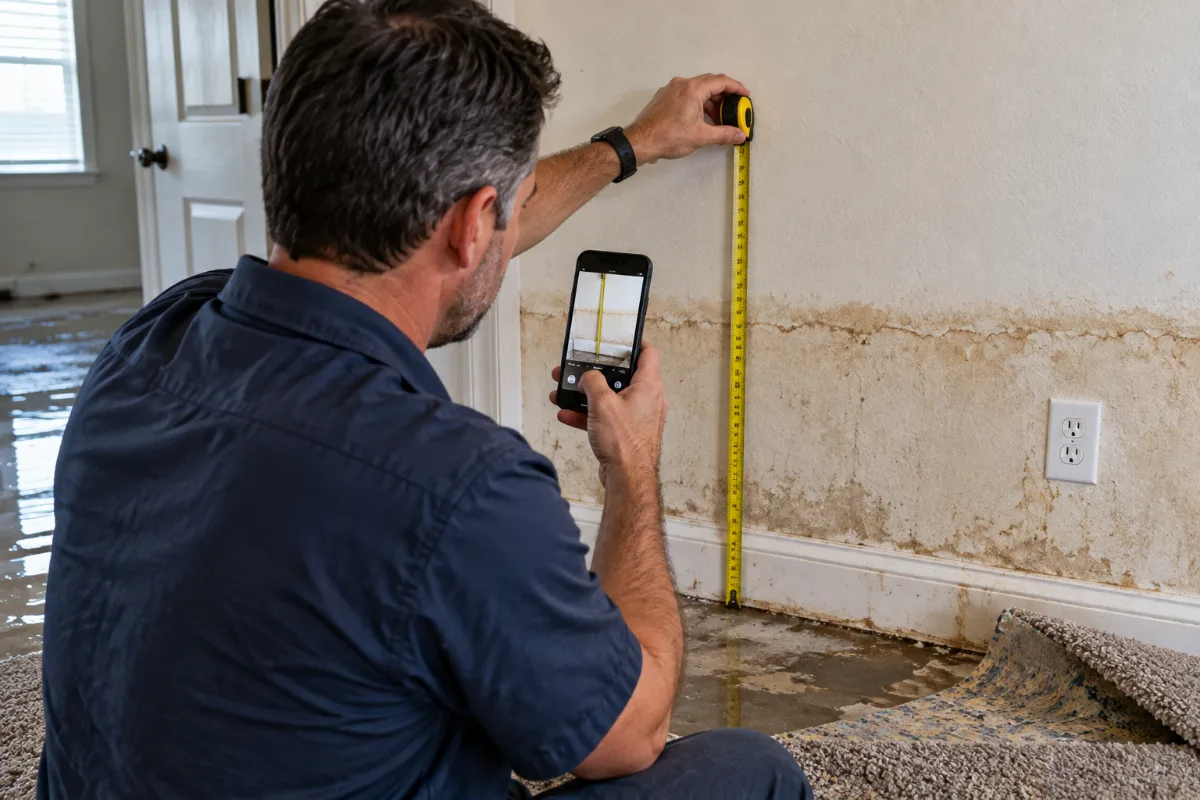
- Water lines marked and measured from the floor in every affected room. Height drives the whole scope of a water damage rental property claim, and it is unrecoverable once you cut the drywall.
- Moisture-meter readings photographed with the display legible.
- Serial numbers and date plates on the condenser, furnace, water heater and appliances.
- A narrated, date-stamped walkthrough video, street to back fence.
- Pre-loss condition evidence — the last move-in inspection, prior listing photos, the most recent roof invoice. This defeats a “pre-existing wear” denial.
- A written contents list with dates and values.
- Physical samples on site: bagged shingles and wet drywall, kept until the adjuster has seen them.
The claim clock: every deadline and who it binds
Prompt-payment rules live in Subchapter B of the Texas Insurance Code Chapter 542, and they bind the carrier. The only deadlines binding an owner are the policy’s reporting deadline and the pre-suit notice below.
| Step | Deadline | Authority | Binds |
|---|---|---|---|
| Acknowledge, start investigating, request what it needs | 15 days after notice of claim (30 business days, surplus lines) | 542.055 | Insurer |
| Accept or reject in writing, with reasons if rejected | 15 business days after receiving all requested items (30 days if arson is suspected) | 542.056 | Insurer |
| If it cannot decide in time, explain why — then decide | Notice in the original window; decision within 45 days of it | 542.056(d) | Insurer |
| Pay an accepted claim | 5 business days after acceptance (20 business days, surplus lines) | 542.057 | Insurer |
| Outer limit before penalties attach | More than 60 days after receiving all items | 542.058 | Insurer |
| Weather-catastrophe extension | All of the above, plus 15 days | 542.059(b) | Insurer |
| Penalty for missing them | 18% a year plus fees; under 542A, the Finance Code 304.003 judgment rate plus five points, plus fees | 542.060 | Insurer |
| Written pre-suit notice before filing suit | At least 61 days before filing | 542A.003 | Owner |
| Filing the claim itself | Policy-driven; one year from the damage date on a TWIA policy | Policy; 2210.205, 2210.573 | Owner |
The 15-day acknowledgement in 542.055 is written in calendar days, though TDI’s plain-language pages call them business days — assume the shorter period. And the 542.056 and 542.057 clocks only start once the carrier has everything it asked for, which is why an organized submission beats a phone call.
Coastal owners often ask whether they need separate windstorm cover. Under the TWIA eligibility rules, the catastrophe area covers 14 first-tier coastal counties plus only the part of Harris County east of State Highway 146 that also sits inside La Porte, Morgan’s Point, Pasadena, Seabrook or Shoreacres.
Most of Houston is not in the TWIA catastrophe area, and both conditions above must be met for a Harris County property to qualify. If your rental is in the Heights, Katy, Cypress or Kingwood, wind and hail belong on your standard policy — and flood on a separate one, because no property policy covers rising water.
Why the first check is smaller than the estimate
This is the most common panic call after a roof damage insurance claim is accepted, and nothing has gone wrong: a replacement cost policy pays in two instalments. TDI’s comparison of replacement cost against actual cash value shows why the gap looks alarming.
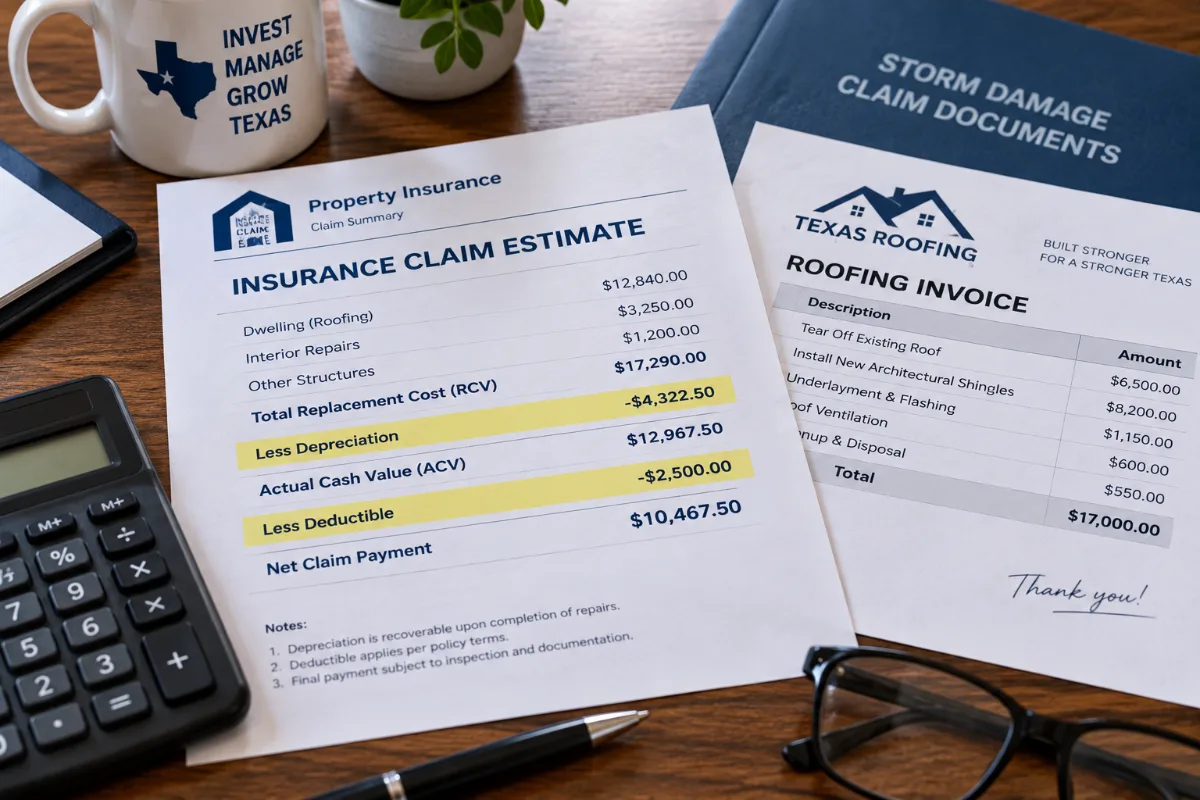
Worked example. A rental insured for $300,000 with a 2% wind and hail deductible ($6,000). The adjuster writes the 12-year-old roof as a total loss at $18,000 replacement cost and applies 35% depreciation — $6,300.
| Line | Amount |
|---|---|
| Replacement cost value of the roof | $18,000 |
| Less depreciation (35%) | −$6,300 |
| Actual cash value | $11,700 |
| Less deductible | −$6,000 |
| First check | $5,700 |
| Recoverable depreciation, released once the work is invoiced | +$6,300 |
| Total paid by the carrier | $12,000 |
| Your out-of-pocket cost | $6,000 (the deductible) |
That $6,300 is recoverable depreciation. You get it by finishing the work and sending the final invoice, not by arguing. On an actual cash value policy the carrier pays $5,700 and stops, leaving you to fund $12,300 of an $18,000 roof. On a mortgaged property, large checks are usually payable to you and the lender jointly and released in draws.
Hiring the contractor without creating a second problem
Texas does not license roofing contractors. HB 3344 in the 2025 session would have created a state license through the Texas Department of Licensing and Regulation, but it died in committee on 8 May 2025. The vetting burden is yours.
- Confirm the legal entity with the Secretary of State and match it to the contract.
- Get a certificate of liability and workers’ compensation cover direct from the insurer, not the salesperson.
- Insist on a Texas address and a line-item bid you can lay beside the adjuster’s estimate.
- Never pay in full up front, never sign a contract with blank spaces, read any assignment of benefits first.
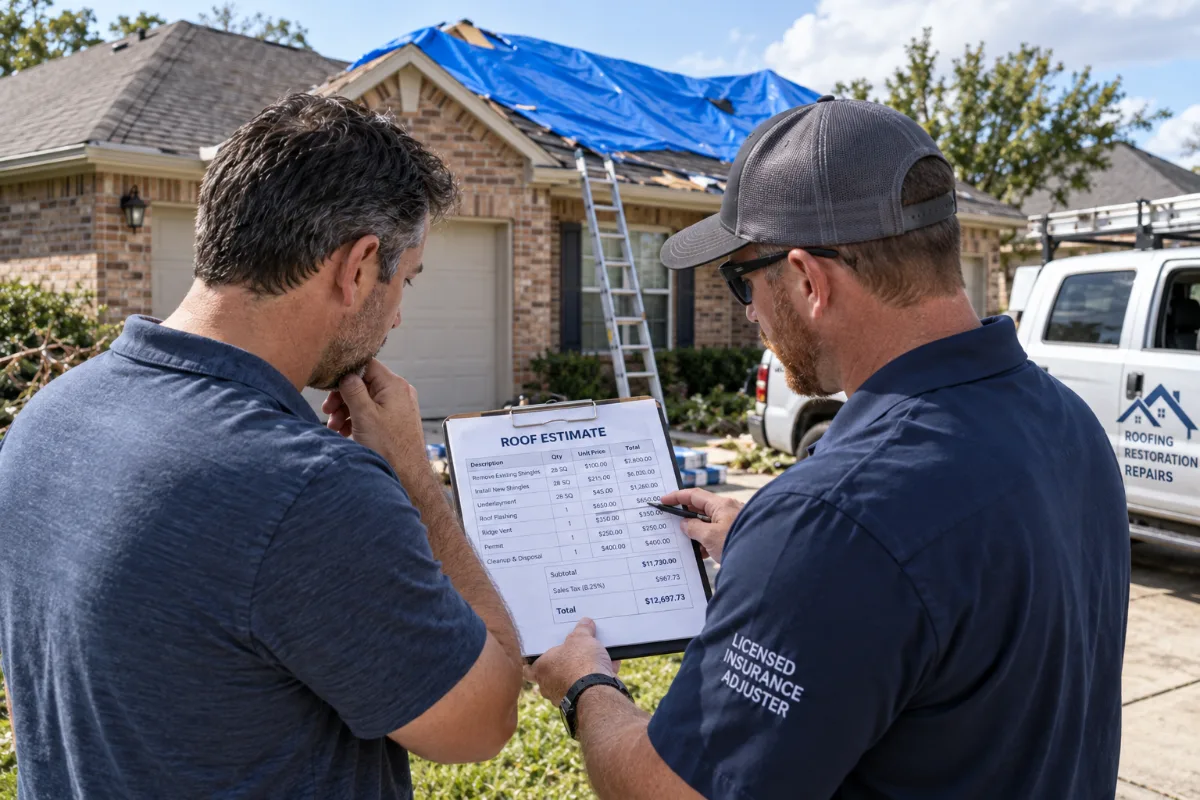
- Compare three written bids, and route scope disagreements back through the adjuster.
Two legal lines matter. Insurance Code 4102.163 bars a contractor from acting as a public adjuster, or advertising to adjust claims, on any property where that contractor is providing or may provide contracting services; the TDI guidance on roofing and insurance is blunt about the advertising language that crosses the line. A public insurance adjuster is a different person entirely — licensed by TDI, capped at 10% of the settlement under Insurance Code 4102.104, and barred by 4102.151 from soliciting you while the storm is still under way. Business and Commerce Code 27.02 separately makes deductible absorption a crime, and Chapter 707 requires you to pay it.
Paying, waiving, absorbing or rebating your deductible on an insurance-funded job is a Class B misdemeanor in Texas, and any such contract of $1,000 or more must carry a boldface notice saying so. Your carrier can demand a receipt or canceled check. The out-of-town crew with a “we’ll eat your deductible” pitch is proposing a crime you would be party to, on a roof you will still own in ten years.
Rent, habitability and what you owe the tenant
Property Code 92.052 requires a diligent effort to repair conditions that materially affect an ordinary tenant’s health or safety, once the tenant gives notice and is not delinquent in rent. Section 92.056 presumes seven days is a reasonable time to repair — a presumption rebuttable by the severity of the condition and the availability of materials and labor, which is exactly the post-hurricane situation.
The provision that changes the timeline is Section 92.054 of the Texas Property Code. Subsection (a) is the one to know: where the condition results from an insured casualty loss such as fire, smoke, hail or explosion, the period for repair does not begin until the landlord receives the insurance proceeds. That protection is only as good as your file, so keep the claim number, every carrier communication and the payment record — and send the tenant a short written update every week. The broader duties sit in our guide to Texas landlord-tenant law.
When the unit is uninhabitable
| Situation | What the law says | Rent | Your next step |
|---|---|---|---|
| Repairs needed, proceeds not yet received | Repair period does not start until proceeds arrive — 92.054(a) | Continues unless (b) or (c) applies | Document the claim timeline |
| Totally unusable, no tenant fault | Either party may terminate by written notice before repairs finish — 92.054(b) | Pro rata refund from move-out, plus deposit | Serve or answer notice; settle the deposit on time |
| Partially unusable, no tenant fault | Proportionate reduction, but only on judgment of a county or district court unless the lease says otherwise — 92.054(c) | Negotiate or litigate | Put any agreed reduction in a signed amendment |
| Damage caused by tenant, family or guest | Repair duty does not apply — 92.052(b); 92.054 relief needs no tenant fault | Continues | Document causation before repairs |
| Tenant stays while work proceeds | Health-and-safety duty continues, subject to 92.054 timing | Continues absent agreement | Schedule access, secure the site |
A casualty termination under 92.054 is not an eviction — the Houston eviction process is a separate track with its own notice requirements.
If the carrier underpays or denies
Start inside the policy. Ask for the full estimate and adjuster’s report, set your contractor’s line-item bid beside it, and dispute scope in writing with photographs attached. Most gaps are scope disputes, not coverage disputes. If the argument is purely about amount, most policies contain an appraisal clause that settles it without litigation, and TWIA has its own process under Chapter 2210. If the problem is conduct, complain to TDI at 800-252-3439.
Litigation has a gate. Chapter 542A of the Insurance Code, added in 2017, covers first-party claims for damage caused wholly or partly by forces of nature. Section 542A.003 requires written pre-suit notice at least 61 days before filing, stating the acts or omissions complained of, the specific amount alleged owed, and attorney’s fees to date. Section 542A.007 ties recoverable fees to the ratio between what you demanded and what you win, so an inflated demand shrinks the award. Two carve-outs: 542A.002(b) excludes actions against TWIA, and 542A.006 lets an insurer accept its agent’s liability and have the agent dismissed. Call a Texas attorney here, not a contractor.
The hard part is that it all lands in the same fortnight, while your phone is full of tenants, contractors and a carrier counting days only from the moment it has everything it asked for. Owners who come through a Gulf Coast season intact documented first and negotiated second. If you would rather not run that yourself, Houston property management is the function that absorbs it — inspection, claim file, contractor vetting, tenant updates and the paper trail that makes a disputed claim winnable.
Texas Lone Star Property Management handles post-storm inspections, claim documentation, contractor vetting and tenant communication for owners across Houston and Harris County, so the file is built properly from day one. Contact us for a no-obligation review of your property and coverage.
Frequently Asked Questions
How long do I have to file a storm damage insurance claim in Texas?
Texas does not set a general statutory deadline for a policyholder to report a loss to a private carrier. Your policy does. Most residential property policies require prompt notice and many contain a one-year reporting deadline. The one hard number in statute applies to the Texas Windstorm Insurance Association: Insurance Code 2210.205 and 2210.573 require a TWIA claim to be filed no later than the first anniversary of the date the damage occurred, and only the commissioner can extend that, by up to 180 days for good cause. Read your declarations page and call TDI at 800-252-3439 if the wording is unclear.
How fast does my insurer have to respond?
Under Insurance Code 542.055 the carrier has 15 days from receiving notice of the claim to acknowledge it, begin its investigation, and request everything it reasonably believes it will need. Under 542.056 it then has 15 business days after receiving those items to accept or reject the claim in writing, and under 542.057 five business days to pay once it says it will pay. Section 542.059 adds 15 days to every one of those deadlines when the commissioner declares a weather-related catastrophe.
Why was my first insurance check so much smaller than the repair estimate?
Because a replacement cost policy pays in two parts. The first payment is the replacement cost of the damaged item minus depreciation minus your deductible. The withheld amount is called recoverable depreciation, and the carrier releases it after the work is finished and you send the final invoice. If your policy is written at actual cash value instead, there is no second payment — the depreciation is simply gone.
Does my Harris County rental need TWIA windstorm coverage?
Almost certainly not. TWIA’s designated catastrophe area covers 14 first-tier coastal counties plus only the part of Harris County east of State Highway 146, inside the city limits of La Porte, Morgan’s Point, Pasadena, Seabrook or Shoreacres. A property in central Houston, Katy, Cypress, Spring or Kingwood is outside that area, and wind and hail should be covered by the standard property policy.
Can my roofer pay or absorb my deductible?
No. Business and Commerce Code 27.02 makes it a Class B misdemeanor for a contractor to pay, waive, absorb, rebate or otherwise help you avoid paying the deductible on an insurance-funded job, and Insurance Code Chapter 707 requires you to pay it. Any contract of $1,000 or more that will be paid from insurance proceeds must carry a boldface notice saying so, and your carrier can demand proof of payment.
Does Texas license roofing contractors?
No. There is no statewide roofing license in Texas. HB 3344 in the 2025 session would have created one through the Texas Department of Licensing and Regulation, but it died in the House after being reported out of committee on 8 May 2025. Vetting is entirely on you: verify the entity with the Secretary of State, get a certificate of insurance direct from the insurer, and check the Attorney General and Better Business Bureau.
Do I still owe the tenant a habitable unit while I wait on the insurance money?
You still owe the duty, but the clock is different. Property Code 92.052 requires a diligent effort to repair conditions that materially affect health or safety after written notice. Section 92.054(a) then says that when the condition results from an insured casualty loss, the period for repair does not begin until you receive the insurance proceeds. Document the claim file so you can show the delay is the carrier’s, not yours.
Can the tenant stop paying rent because the property was damaged?
Not unilaterally. Under 92.054(b), if the premises are as a practical matter totally unusable for residential purposes through no fault of the tenant, either party may terminate the lease in writing before repairs are finished, and the tenant gets a pro rata rent refund plus the deposit. Under 92.054(c), if the premises are only partially unusable, the tenant is entitled to a proportionate rent reduction only on the judgment of a county or district court, unless your written lease says otherwise.


