
A lease is the single most important document in the landlord-tenant relationship. Get it right and it prevents disputes, protects your property, and holds up if you ever need to enforce it. Get it wrong – vague terms, missing disclosures, an unenforceable late-fee clause – and it becomes the thing a tenant’s attorney uses against you.
This guide walks Houston landlords through what a Texas residential lease agreement must include in 2026, clause by clause, grounded in the Texas Property Code. Use it to review a template before you sign, or to spot the gaps in the lease you are already using.
This article is general information for Texas property owners and is not legal advice. Landlord-tenant law changes and every situation is different – consult a licensed Texas attorney before finalizing or relying on any lease.
The basics every Texas lease needs
Start with the fundamentals. A valid, enforceable lease clearly identifies:
- The parties – the legal names of every adult tenant and the landlord or managing agent.
- The property – the full address and any included spaces (garage, storage).
- The term – start and end dates, and whether it renews month-to-month after.
- Rent – the amount, due date, accepted payment methods, and where or how it is paid.
These sound obvious, but ambiguity here is where disputes begin. Spell everything out.
Required disclosures under Texas law
This is where template leases most often fall short. Texas law and federal law require specific disclosures, and omitting them can expose you to liability:
- Owner or agent name and address – so the tenant knows who to notify for repairs and legal notices (Texas Property Code Chapter 92).
- 100-year floodplain disclosure – under Section 92.0135, you must tell the tenant if the dwelling is in a 100-year floodplain or has flooded at least once in the past five years. In flood-prone Houston, this clause matters more than almost anywhere in Texas.
- Security device and repair-remedy notices – the lease must inform tenants of their rights regarding security devices and the repair process.
- Lead-based paint disclosure – required by federal law for any dwelling built before 1978.
You can read the governing statute directly in the Texas Property Code, Chapter 92(opens in new tab), and see a plain-language summary in the Texas Attorney General’s tenant rights guide(opens in new tab).
Security deposit terms
Your lease should state the deposit amount and the conditions for its return. Texas does not cap the deposit, but Section 92.103 requires you to refund it or provide an itemized list of deductions within 30 days of the tenant surrendering the property.
Document the property’s condition with dated photos or video at move-in and move-out. If you plan to deduct for damage, the lease should require the tenant’s forwarding address in writing – without it, the 30-day clock and your obligations shift. Clear records make deductions defensible.
Late fees and NSF charges
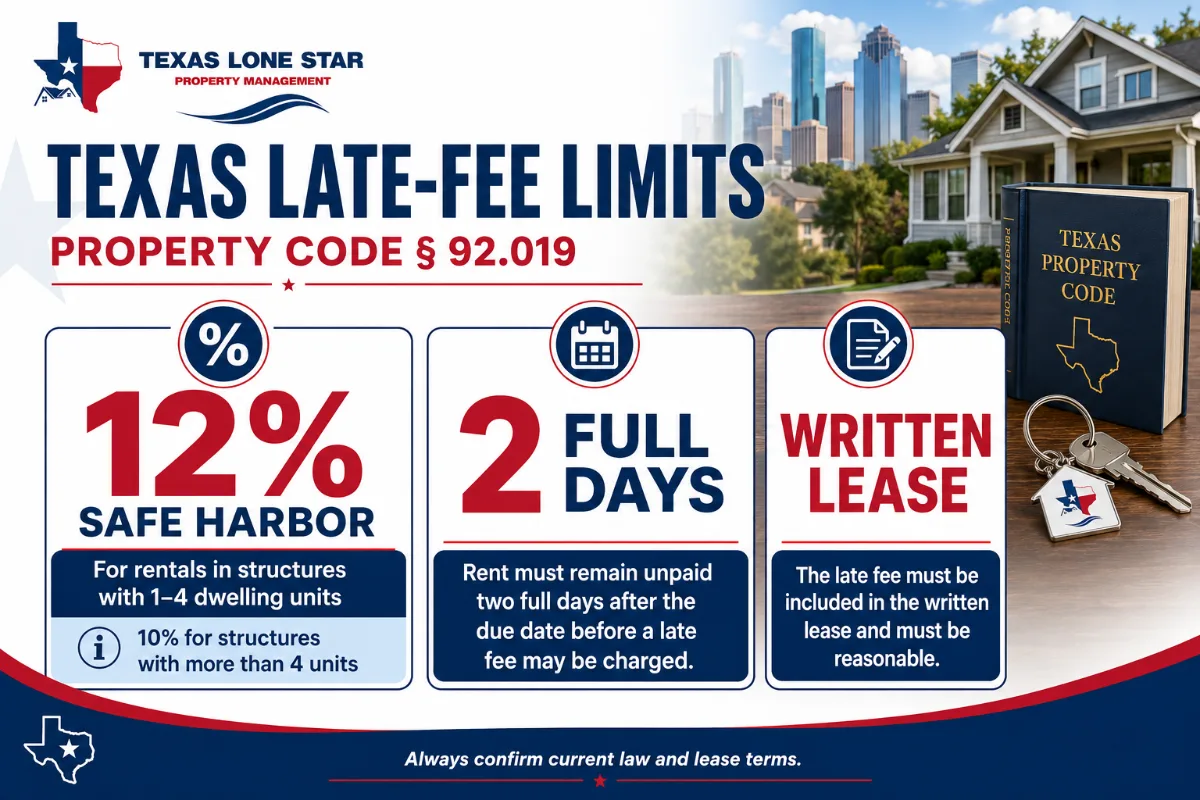
Late-fee clauses are a frequent source of legal trouble because owners write them too aggressively. Under Texas Property Code Section 92.019:
- A late fee may only be charged if rent remains unpaid at the end of the second day after the due date.
- The fee must be a reasonable estimate of the landlord’s costs from the late payment.
- It is presumed reasonable if it does not exceed 12% of the monthly rent for a property with four or fewer dwelling units (10% for larger properties).
Spell out the exact late fee and any returned-check (NSF) fee in the lease.
Landlord entry and access
Unlike some states, Texas law does not impose a specific statewide notice period before a landlord can enter. That makes your entry clause essential – it is the document that governs access. A strong clause specifies:
- The notice you will give (24 hours is a common, tenant-friendly standard).
- The permitted reasons – repairs, inspections, showing the unit, emergencies.
- That emergencies allow immediate entry without notice.
Putting this in writing prevents the “you can’t just show up” disputes that otherwise have no clear resolution under Texas law.
Maintenance, repairs, and habitability
Texas landlords have a duty to repair conditions that materially affect the health or safety of an ordinary tenant. Your lease should:
- Explain how tenants request repairs (in writing, to a specific contact).
- Define tenant responsibilities: lawn care, filter changes, reporting issues promptly, and not causing damage.
- Address who handles pest control, HVAC servicing, and similar recurring items.
Clear maintenance terms reduce friction and help you meet your obligations under Texas landlord-tenant law.
Rules, addenda, and other key clauses
Round out the lease with the provisions that prevent the most common conflicts:
- Occupancy limits and a guest policy.
- Pet policy – allowed or not, pet deposit or fee, and any restrictions.
- Subletting and assignment terms.
- Renters insurance requirement (smart in flood-prone Houston).
- Parking and towing rules, and any HOA rules the tenant must follow.
- Default and remedies – what happens if rent is unpaid, which ties into the formal Houston eviction process if it comes to that.
Common addenda include a lead-paint addendum, pool/spa addendum, and community rules.
Should you use a free lease template?
Free Texas lease templates are everywhere, and they can be a reasonable starting point for understanding structure. But generic templates often miss Houston-specific and 2026-current requirements – the floodplain disclosure, correct late-fee language, and proper deposit terms. A lease that is missing a required disclosure or contains an unenforceable clause can cost you far more than a properly drafted one ever would.
At minimum, have a Texas attorney review any template before you rely on it. For a deeper look at your obligations, see our overview of Texas landlord-tenant law.
Texas Lone Star Property Management uses attorney-reviewed, Texas-compliant leases for every Houston rental we manage – so your disclosures, deposit terms, and late-fee clauses hold up. Contact our team to learn more.
General information for Texas property owners – not legal advice. Consult a licensed Texas attorney before finalizing any lease.
Frequently Asked Questions
Is a written lease required in Texas?
A lease can be oral or written in Texas, but a written lease is strongly recommended and, in practice, essential. Written terms protect both parties and are far easier to enforce – and certain provisions, like some late-fee and deposit terms, are only reliable when they are in writing.
What disclosures are required in a Texas lease?
Texas landlords must disclose the name and address of the owner or managing agent, provide security-device and repair-remedy information, and, under Texas Property Code Section 92.0135, disclose if the dwelling is located in a 100-year floodplain or has flooded in the past five years. For homes built before 1978, a federal lead-based paint disclosure is also required.
How much can a Texas landlord charge for a late fee?
Under Texas Property Code Section 92.019, a late fee must be a reasonable estimate of costs and can only be charged if rent is unpaid by the end of the second day after it is due. A fee is presumed reasonable if it does not exceed 12% of the rent for a property with four or fewer units (10% for larger properties).
How long does a Texas landlord have to return a security deposit?
Texas Property Code Section 92.103 gives landlords 30 days after the tenant surrenders the property to refund the deposit or provide an itemized list of deductions.
Does a Texas landlord have to give notice before entering?
Texas law does not set a specific statewide notice period for entry. Entry rights are governed by what the lease says, which is exactly why a clear entry clause is so important — put the required notice and permitted reasons in writing.